
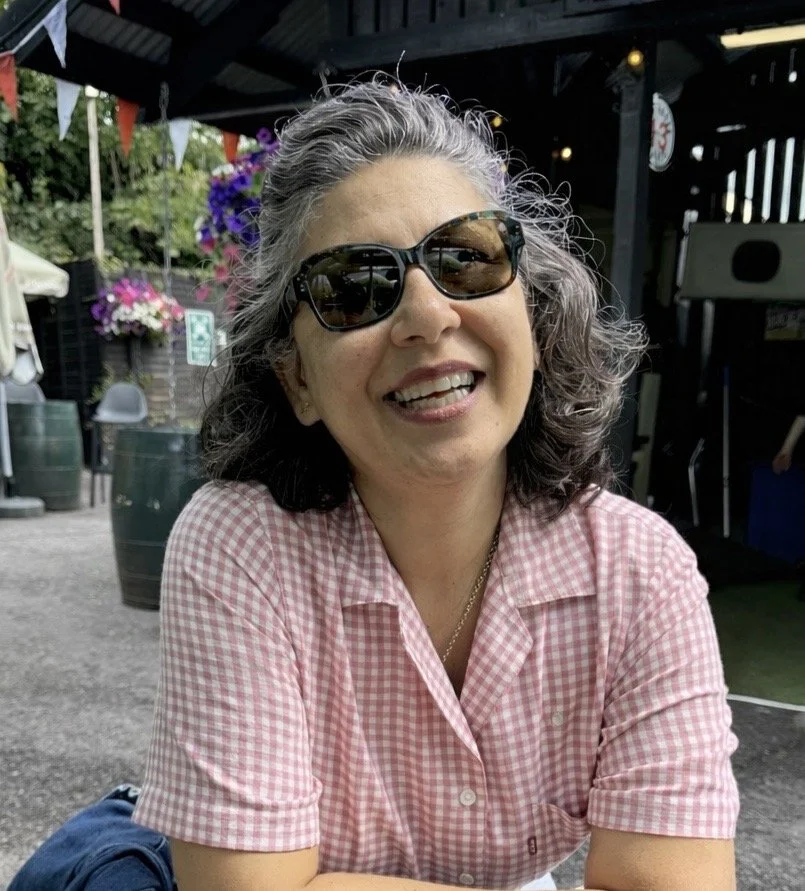
I grew up in a house where a great deal went unsaid, in a country that had recently made saying things dangerous.
For years I thought of that as history. Now I think of it as training. Most of my adult life has gone into learning to say true things out loud, and then into helping other people do the same.
The outline is simple enough: Tehran, the revolution and the long grey decades after it, the crossing to the United States in 2004, a graduate degree, a corporate career, my daughter beside me again. The architecture of a life that was supposed to feel like arrival, and didn't.
What happened next
I want to tell you the part that comes after the outline, because it's the reason I do this particular work rather than something adjacent to it.
I wrote a memoir. My Persian Paradox took years, and it did what writing does — it gave shape to things that had been formless in me for decades, put language to contradictions I'd been carrying without names. By the end I understood myself better than I ever had. I could account for how I'd become who I was. I could explain it to a room.
And then I went on behaving more or less the way I had before.
That was the surprise, and it turned out to be the most useful thing that has ever happened to me professionally. I had assumed that understanding would be enough — that if I could only see the pattern clearly, the pattern would loosen. It doesn't work that way. Insight is where change becomes possible. It is not the place where change occurs. The distance between the two is where most of us live for years, sometimes for good.
So I went looking for people who had studied that distance. I found the field of adult development — a body of work concerned not with what we know but with how we make meaning, and how that capacity can actually grow over a lifetime. I trained as an Integral Coach at New Ventures West and certified through the International Coaching Federation, and I have been working at that particular seam ever since.
What this means for how I work
I'm not primarily interested in helping you build a better account of yourself. You may already have an excellent one. Many of the people I work with are articulate, self-aware, and thoroughly stuck — they can narrate the problem with real precision and have been narrating it for some time.
What I'm after is the thing underneath the account. The commitment you're honoring by not changing. The assumption so deep you've never had to state it, because it has never occurred to you that it might be optional. Those don't come out through explanation. They come out through slower, stranger routes — writing, attention to the body, staying with a question past the point where you've produced a satisfying answer to it.
You should know that this involves work between sessions, and that it is often uncomfortable before it is useful. I will ask you to write. I will notice when you're explaining rather than looking, and I'll say so, because that's what you're paying me for. I'm not going to hurry you toward resolution.
I also spent a long career inside organizations — a master's in systems engineering, project management credentials, years of corporate work. When you tell me about the job that's hollowing you out, I'm not hearing it from the outside.
Individual coaching runs in engagements of at least 6 months, meeting regularly [every week / every other week/once a month] for 60 minutes, online or in person. There are practices, reflection, and journaling in between the sessions that make our work together flourish.
I hold a small number of reduced-fee places at any given time; ask me if cost is the obstacle.
We start with a chemistry session: a free hour to talk about what brings you here and how I work, so we can both sense whether this is right. There's no obligation on either side, and I'd rather tell you honestly if I think someone else would serve you better.
Education & Credential
Certified Integral Coach — New Ventures West professional coach training
International Coaching Federation certified
Author, My Persian Paradox (memoir)
Master's degree, Systems Engineering
Bachelor's degree, Business
Project Management Professional (PMP)®